
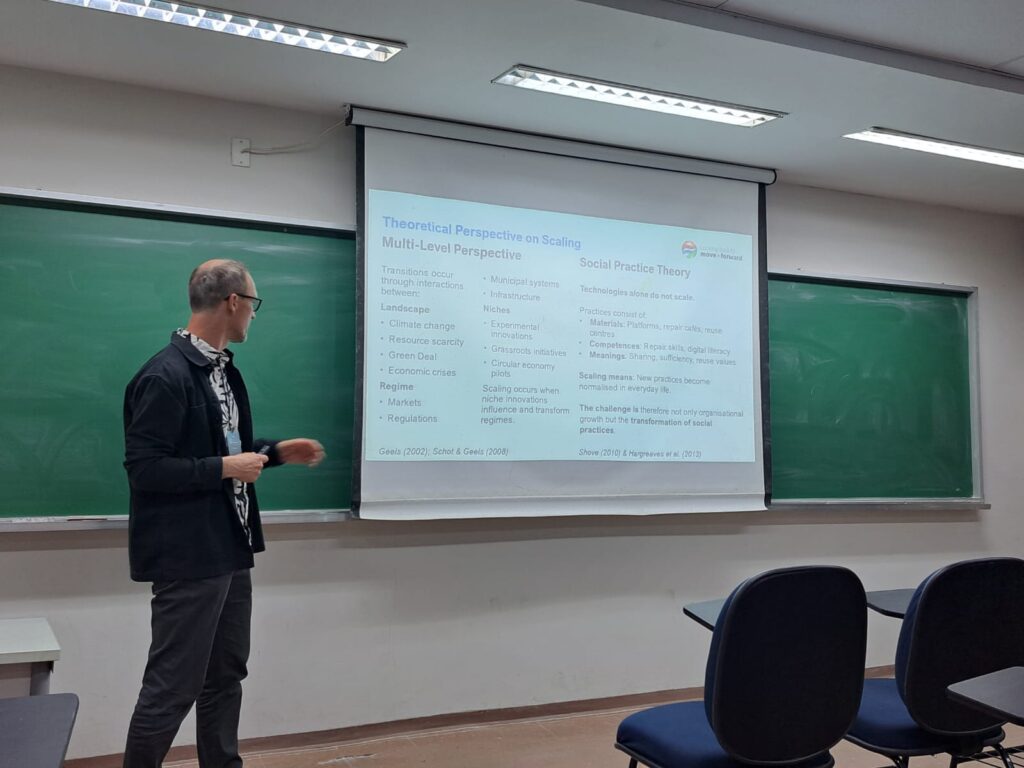
The TransScale project was presented at the SCORAI Europe Conference 2026, where Dr. Jānis Brizga (University of Latvia) shared the project’s latest research on the barriers and enablers for scaling Circular and Sharing Economy (CSE) initiatives across Europe.
The presentation, “From Niche to Regime: Barriers and Enablers for Scaling Circular and Sharing Economy Initiatives in Europe,” showcased findings from the TransScale project, which examines circular economy initiatives in Latvia, Norway, Denmark, and Poland. The research draws on case studies, stakeholder workshops, policy workshops, and literature review to better understand how successful circular initiatives can move beyond isolated pilot projects and become mainstream practices.
A key message of the presentation was that the main barriers to scaling are not technological, but rather institutional, cultural, and infrastructural. Fragmented governance, limited policy support, insufficient funding, and existing market structures continue to prevent promising circular initiatives from becoming embedded within everyday urban systems.
The research also introduced the TransScale Scaling Framework, highlighting four key elements necessary for successful scaling:
- Clear policy signals and supportive governance;
- Physical and digital infrastructure;
- Sustainable hybrid business models;
- Social practice change that normalizes circular behaviours.
The presentation concluded that circular economy initiatives do not scale simply because organizations grow. Instead, scaling occurs when governance, infrastructure, markets, and social practices evolve together, enabling circular solutions to become part of the dominant socio-technical regime.
Participation in SCORAI Europe 2026 provided an excellent opportunity to disseminate TransScale research, exchange knowledge with leading international researchers and practitioners, and contribute to discussions on accelerating Europe’s transition towards more circular and sustainable cities.