
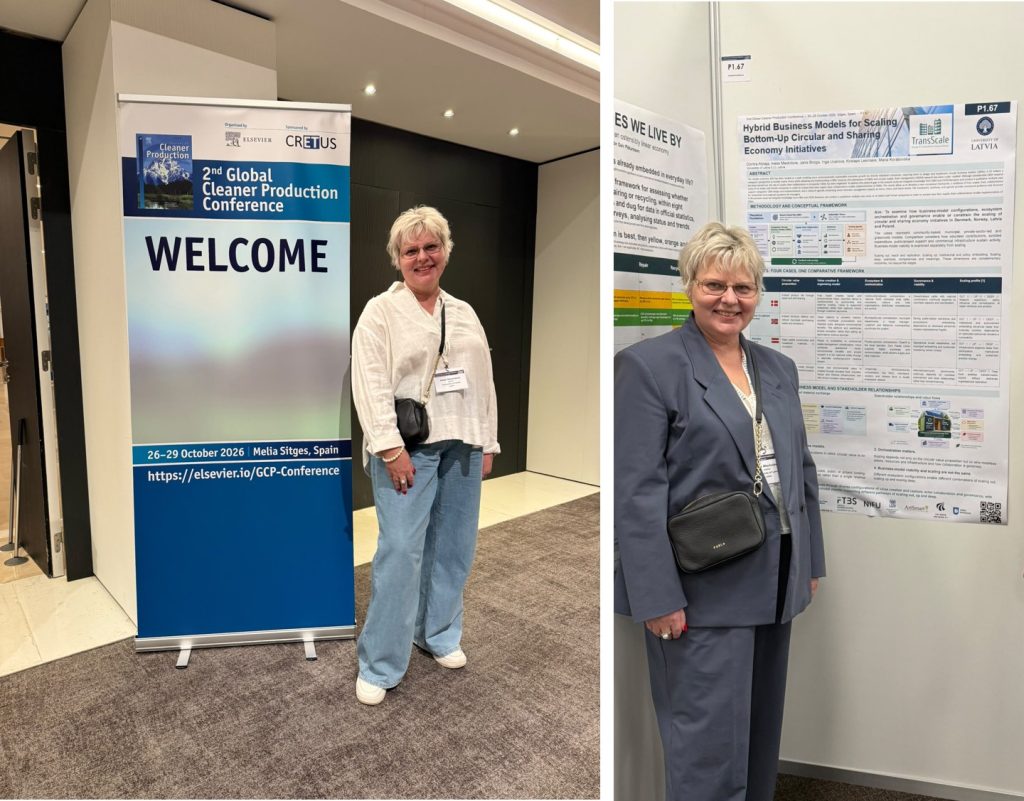
Dzintra Atstāja and Inese Mavlutova represented the University of Latvia and the TransScale project at the 2nd Global Cleaner Production Conference, held on 26–29 October 2026 in Sitges, Spain, where they presented the team’s research poster.
The poster explored how business models, stakeholder collaboration and governance influence the scaling of circular and sharing economy initiatives. It compared four cases: Repair Café in Denmark, Asker/Loopfront in Norway, Nomales in Latvia and Długi Stół in Poland.
The comparison examined three complementary scaling pathways: reaching more people and replicating initiatives (scaling out), embedding circular approaches in institutions and policies (scaling up), and strengthening everyday practices, skills and values (scaling deep).
A central conclusion is that circular initiatives depend on cooperation across organisations and communities. Their viability can draw on a combination of revenue, avoided costs, public or project funding, volunteer contributions, and social and environmental benefits. The research also distinguishes between sustaining an initiative and enabling it to scale.
The poster included a proposed business model for a material exchange point and a stakeholder framework relevant to CleanR, connecting the comparative research with practical opportunities for material reuse in Latvia.
The poster was authored by Dzintra Atstāja, Inese Mavlutova, Jānis Brizga, Inga Uvarova, Kristaps Lesinskis and Marija Korabovska.
The presentation shared TransScale’s findings with an international audience and contributed to the discussion on how local circular initiatives can support wider systemic change.