
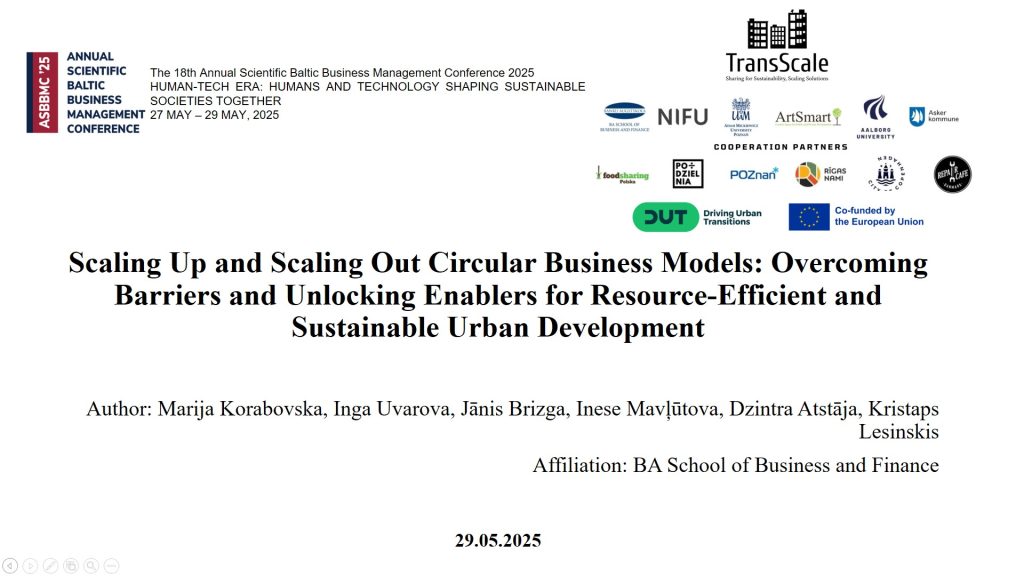
Date: 29 May 2025
Location: Riga, Latvia
Event Theme: HUMAN-TECH ERA: Humans and Technology Shaping Sustainable Societies Together
We are pleased to announce that our project team actively participated in the 18th Annual Scientific Baltic Business Management Conference 2025, presenting cutting-edge research on advancing circular and sharing economy initiatives in urban settings.
🎤 Presentation Title:
“Scaling Up and Scaling Out Circular Business Models: Overcoming Barriers and Unlocking Enablers for Resource-Efficient and Sustainable Urban Development”
📚 Authors: Marija Korabovska, Inga Uvarova, Jānis Brizga, Inese Mavļūtova, Dzintra Atstāja, Kristaps Lesinskis
🏫 Affiliation: BA School of Business and Finance
🔍 Research Focus
The presentation highlighted how cities, especially in post-socialist regions, face interconnected environmental and socio-economic challenges—from biodiversity loss to resource scarcity. Our research examined how circular and sharing economy (CSE) initiatives can address these challenges, and more importantly, how they can be scaled effectively through cross-sectoral governance, digital tools, and inclusive stakeholder collaboration.
🚧 Key Barriers Identified:
- Limited awareness and systemic resistance to change
- Infrastructure and logistical bottlenecks in rural and urban regions
- Regulatory inconsistencies and market inertia
- Financial and institutional gaps, especially for SMEs
🧩 Key Enablers Proposed:
- Strategic policy alignment between local and national levels
- Stable public-private funding mechanisms
- Education, community engagement, and multi-stakeholder cooperation
- Innovation hubs, digital platforms, and performance monitoring systems
🧠 Methodology
Our approach combined:
- Case studies from four European countries
- Future Literacy Labs (FLLs) for scenario exploration
- Policy discussion labs
- Semi-structured interviews
- Life Cycle Assessments and Material Flow Analysis
📢 Impact and Takeaways
Our findings sparked interest across sectors, emphasizing the role of cultural, institutional, and behavioral dimensions in unlocking circular transformation. The conference provided a valuable platform for exchange with scholars and practitioners working at the interface of sustainability, innovation, and policy.
We thank the organizers and participants for the enriching discussions and feedback. This contribution reflects our ongoing commitment to supporting circular transitions across Europe—connecting research, practice, and policy for a sustainable future.